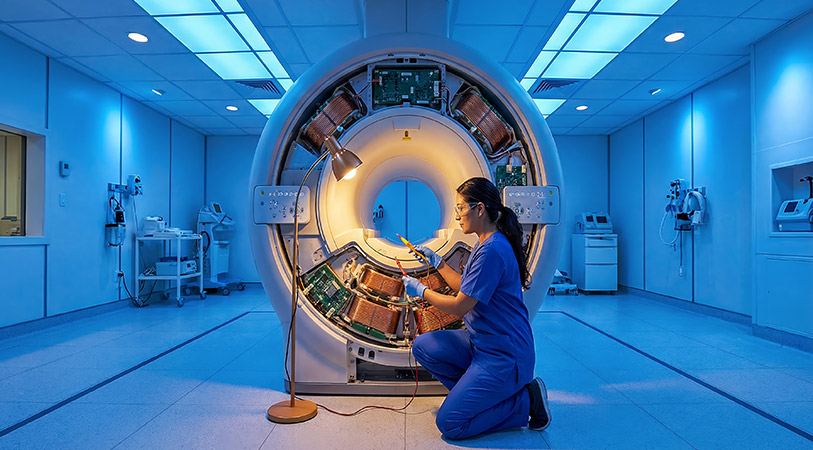
From Procurement to Public Value

Making Medical Technology Work for Government Healthcare Systems
Across India, the Middle East, and North Africa, governments are investing heavily in public healthcare infrastructure. Yet one issue consistently determines success or failure:
Medical technology delivers value only when it stays operational.
In public healthcare systems, downtime is not an inconvenience—it is lost access to care.
The Gap in Public Healthcare Technology
Most government programmes still treat medical equipment as a procurement exercise. In reality, the real challenge begins after installation.
Common systemic issues include:
- Fragmented service responsibility
- Multi-vendor, multi-contract environments
- Limited repair and refurbishment pathways
- Skills gaps at hospital and district levels
- Rising replacement costs and underutilised assets
The outcome is predictable: high capital investment with uneven clinical impact.
What Lifecycle Accountability Looks Like in Practice
In India, Cyrix Healthcare manages entire state-level government hospital systems, covering everything from ECG machines and patient monitors to CT and MRI systems.
Under unified lifecycle management models:
- 98%+ equipment uptime is consistently achieved
- Multi-brand fleets are managed under single accountability
- Preventive maintenance replaces reactive breakdowns
- Board-level repair and refurbishment extend asset life
- Total cost of ownership is significantly reduced
- Clinical departments experience measurable efficiency gains
This approach has enabled state healthcare systems to do more with existing infrastructure, rather than relying on continuous replacement.
Why This Matters for Policy and PPP Models
For national health missions, donor-funded programmes, and PPP frameworks, lifecycle-led management delivers:
- Predictable service outcomes
- Strong audit and compliance visibility
- Reduced long-term CAPEX pressure
- Improved utilisation of public assets
- Alignment with sustainability objectives
Most importantly, it ensures that public investment translates into public health outcomes.
A Model That Scales Across Regions
While the context differs across India, MENA, and North Africa, the principle remains the same:
Public healthcare systems need technology stewardship, not fragmented vendor management.
An integrated medtech ecosystem—service, repair, refurbishment, supply, and skills under one partner—creates resilience at scale.
Continuing the Conversation at WHX Dubai 2026
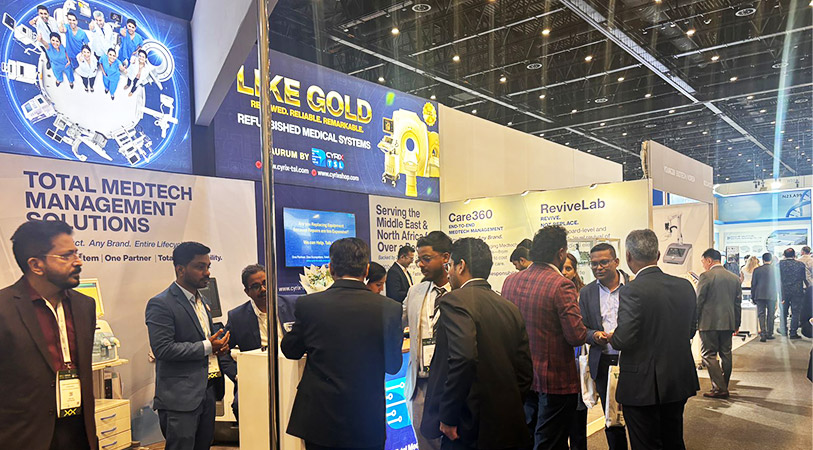
At WHX Dubai 2026, Cyrix TSL will engage with government leaders, health missions, agencies, and PPP stakeholders to discuss proven lifecycle models that strengthen public healthcare delivery.
If your focus is uptime, efficiency, and long-term public value, we invite you to meet our leadership team and explore how medical technology can be governed—not just procured.
One Partner. Total MedTech Management Solutions.
Schedule a Meeting at Cyrix TSL Booth N23.A118